|
|
| Conservation
of the Chinese wallpaper at Woburn Abbey |
|
|
| In March 1997, a conservation project
on the Chinese wallpaper in the Ballroom at Woburn Abbey
was planned by Lord and Lady Tavistock. Meryl Huxtable
of the Paper Conservation Department at the Victoria and
Albert Museum was contacted for advice and she recommended
two British conservators, Mark Sandiford and Philippa
Mapes, who were greatly experienced in this particular
field and who were working at that time on a project in
Ireland. They visited the House and made their report
on the condition and proposed method of conservation which
was accepted and they agreed to start work in April this
year when they had finished working on other Chinese wallpaper
at Ightham Mote for the National Trust. The project is
now complete and the wallpaper is now back in position
in the Ballroom. Further research is being done into the
age of the wallpaper and when it was acquired by the family,
but indications at the moment show that it dates from
the last quarter of the 18th century and into the first
decade of the 19th century. |
 |
|
|
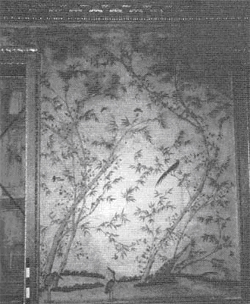
| This charming wallpaper is a nonrepeating
panorama of Chinese bamboo trees, pretty trailing flowers
and exotic birds. its scenic panorama, extending around
the room, portrays typical examples of Chinese flora and
fauna, each element chosen for its symbolic meaning and
relationship between the concepts of Harmony and Nature.
The wallpaper is painted entirely by hand in water-colours
onto extremely thin, hand made sheets of Chinese paper,
which were first pasted together to give a 'length' of
wallpaper. This type of wallpaper was particularly fashionable
in the grand rooms of stately homes in the 18th and early
19th centuries. Along with the general fascination at
the time for all things Oriental, wallpaper such as this
one formed part of the Chinese export trade to Britain.
They were carried, most famously, by the ships of the
East India Company, thus earning themselves the misnomer
of "India Papers". Inked inscriptions found during conservation
on the reverse side of the Woburn wallpaper refer to "Lot
No. 25" and the name 'Royal George' which may shed light
on its original transport and sale.
|  |
|
Condition
The wallpaper
itself had suffered much damage from the fluctuations in temperature
and humidity over the decades: the drying effect of the atmosphere
had caused the wallpaper to become desiccated and brittle, splitting
and cracking and in some cases resulting in loss of the image
area. Similarly, the canvas supporting the wallpaper, which
had originally been stretched taut over the bare wooden walls
had also degraded, turning damagingly acidic, sagging and offering
little support to the wallpaper. At one time, the Ballroom had
also been used as a smoking room. This use, and years of airborne
dust had created a layer of nicotine and dirt on the surface
of the paper giving the whole pictorial scene a dark yellow-brown
hue.
Conservation
A
large conservation project was planned and put into action to
remove the wallpaper completely from the walls of the Ballroom,
clean it, re-line it and then re-hang it back on the walls on
a strong new support. Before the wallpaper could be removed,
the small cut out birds, butterflies and bunches of bamboo leaves,
(supplied by the Chinese workshop to be pasted over the seams
in the paper in order not to break the flow of the panorama)
were carefully removed and set aside for treatment. The seams
themselves were then opened up and the wallpaper taken down
in manageable sections. From there it was transported to the
conservation studio in Lincolnshire where it could be treated
properly.
In the meantime, the walls were prepared to receive the wallpaper
using the latest wallpaper conservation techniques pioneered
by Mark Sandiford with colleagues in Holland. The old canvas
lining was substituted with a modern, longer lasting and more
stable polyester material. Stretched and tacked over the walls
as the canvas was before, this method combined traditional hanging
techniques with the advantage of a more beneficial modern material.
The polyester was then covered with layers of hand made Oriental
paper, in a complex system of linings, similar to those used
in Japanese scroll mounting. By adapting this tried and tested
mounting technique, the best possible support system was offered
for the Chinese wallpaper, taking into account the wallpaper's
dual role as oriental work of art, and as a functioning wallcovering.
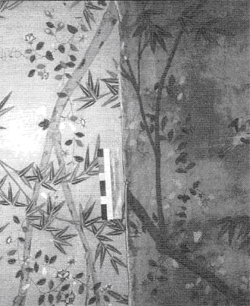
Studio work on the wallpaper involved removing the old degraded
linings, which in many areas had become extremely loose. Following
this, the wallpaper was gently washed to remove more dirt, and
soluble degra dation products. Often a rarity with Chinese wallpaper,
this paper had fortunately never been touched since it was first
hung in the Ballroom. It was not uncommon for expensive, quality
wallpapers such as this to be sold and moved to different houses.
Worse still, many have often been zealously restored and overpainted,
particularly when their subtly shaded backgrounds have become
dirty.
As the Woburn paper was completely intact in this respect, it
was possible to wash out a considerable amount of brown discoloration
to reveal much lighter colour, closer to the original brilliant
white background, hidden by layers of dirt. Furthermore, as
the treatment progressed, the original background sheen returned.
This had originally been achieved using a wash of powdered mica
over the white background colour and giving the whole a shimmering
lustre suggestive of smooth white satin.
Once washed, the paper was relined in its traditional Oriental
manner with hand made sheets of mulberry paper, to provide a
strong and compatible support to the fragile historic wallpaper.
Again, the choice of appropri ate, quality materials is of paramount
importance in ensuring the longevity of the wallpaper.
With the help of carefully recorded documentation and photographs,
the wallpaper could be rehung on the walls in exactly the same
positions as before. Finishing touches included the careful
patching and in-painting of small missing areas and the application
of the cleaned cut-out bamboo leaves from over the seams.
This large conservation project has not only resulted in the
improvement of the aesthetic appearance of the wallpaper, but
has also provided reassurances that the utmost has been done
to ensure the life of the wallpaper has been prolonged as far
as possible. It now remains a beautiful example of Chinese decorative
art, still in its original location, for the appreciation of
generations to come. |
|
|
|